To read the original article in full go to : Fusion Energy: A FutureFactual Deep Dive.
Below is a short summary and detailed review of this article written by FutureFactual:
Fusion Energy: A FutureFactual Deep Dive
FutureFactual Deep Dives take you behind the story, into the science behind the headlines. Handpicked by the FutureFactual team, our Deep Dives bring you the sharpest, most essential content to get you fully up to speed, whatever the topic.
Here, we’ve gathered the most insightful videos, podcasts, and articles from trusted voices exploring the promise and challenges of fusion energy. Together, they’ll bring you up to speed on one of the most ambitious scientific quests of our time - the effort to recreate the power of the stars here on Earth. Whether you're new to fusion or ready to go deeper, these are the pieces worth your time.
THE STORY SO FAR…

Nuclear fusion has long been science’s ultimate energy dream. But what exactly is fusion? Why has it taken so long to make it work on Earth? And why are scientists, governments, and tech companies suddenly convinced that fusion might finally be within reach?
Here’s the lowdown…
WHAT IS NUCLEAR FUSION?
Nuclear fusion is the process that powers the Sun and all the stars. It happens when two very light atoms, usually forms of hydrogen, are pushed together so hard that they fuse into a heavier atom. When this happens, a huge amount of energy is released, as explained in this TED-Ed animated explainer.On Earth, scientists aim to replicate this process using isotopes like deuterium and tritium. Fusion reactors heat fuel to millions of degrees and confine it with magnetic fields or lasers, producing helium nuclei and neutrons. These neutrons transfer energy to heat water, generating electricity.

WHAT COULD FUSION ENERGY DO FOR US?
If achieved, fusion could provide virtually limitless, clean energy from tiny amounts of fuel.
On Earth, scientists are trying to recreate nuclear fusion, at scale, to produce clean, reliable energy. Instead of burning fuel like coal or gas, fusion uses hydrogen taken from water. The challenge is that fusion needs extreme conditions: temperatures hotter than the centre of the Sun and powerful magnetic fields to keep the super-hot fuel contained.
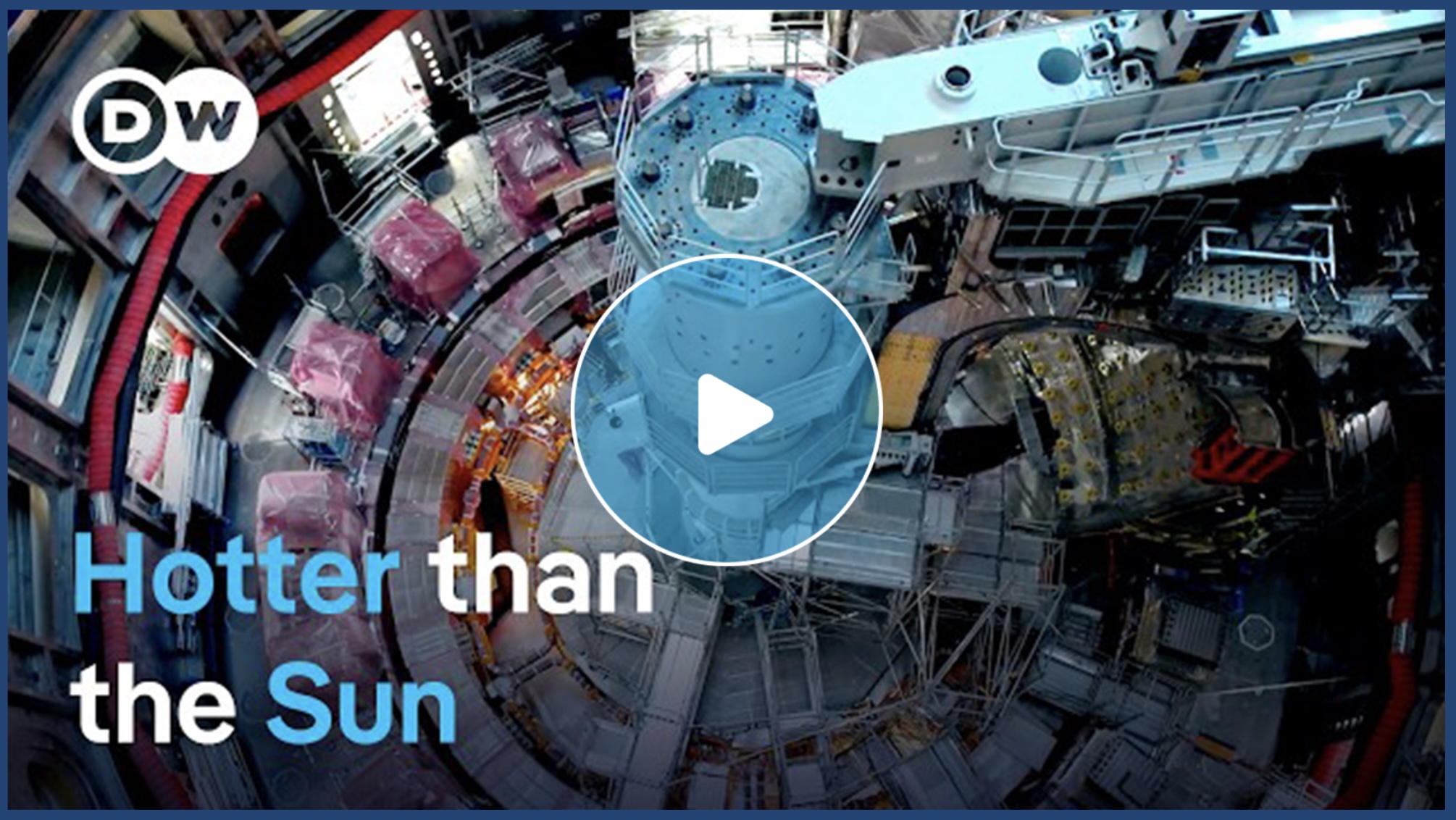
But if we can master it, fusion could provide vast amounts of energy with no carbon emissions, very little long-lived radioactive waste, and no risk of runaway reactions. In short, fusion is a potential game-changer - star power, bottled on Earth. This piece from DW is an excellent, in depth look at fusion’s promise as an endless source of clean energy.
WHAT ARE THE PRACTICALITIES OF DELIVERING IT AT SCALE?
Producing fusion energy at scale requires heating hydrogen plasma to extreme temperatures (we’re talking hotter than the Sun!) and confining it without physical contact. The key challenge is ignition: reaching a point where the reaction produces more energy than it consumes.
In the excerpt below from Neil deGrasse Tyson’s video podcast, Star Talk, Fatima Ebrahimi, a physicist at Princeton Plasma Physics Lab, explains that magnetic fields, like those in tokamak reactors, hold the super-hot plasma in a donut-shaped chamber, while inertial confinement uses powerful lasers to compress tiny fuel pellets. Both approaches aim to reach the “fusion condition,” where more energy is produced than consumed.
While experiments at Princeton, Lawrence Livermore, and elsewhere have achieved localized fusion, scaling it into a practical, 24/7 energy source requires solving engineering challenges like plasma stability, confinement, and net energy gain. Hydrogen’s abundance makes the potential payoff enormous.

WHAT ARE THE CONCERNS?
Nuclear fusion is often described as safer than traditional nuclear power, but it isn’t completely risk-free. Unlike nuclear fission, fusion reactions cannot run out of control or melt down: if conditions aren’t perfectly maintained, the reaction simply stops. That said, fusion reactors still involve hazards.
HOW CLOSE ARE WE TO POWERING THE WORLD WITH NUCLEAR FUSION?
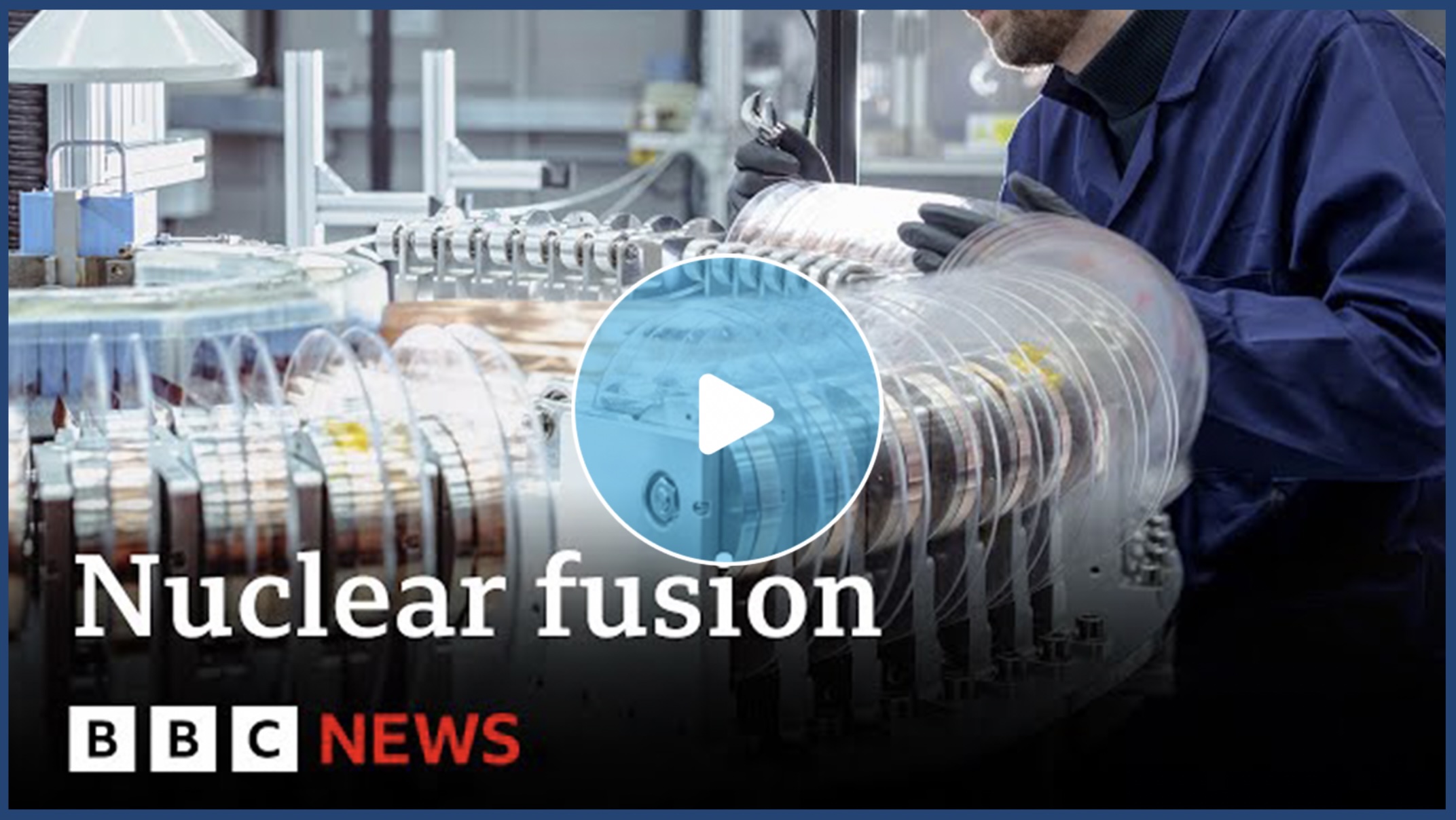
Companies all over the world are racing to commercialise fusion. Here, the BBC spotlights one in particular, ‘Fuse’ in Montreal, who are developing advanced systems like Titan, a one-terawatt pulsed-power driver capable of precise, extreme-energy bursts.
While these innovations demonstrate progress, experts warn that practical fusion energy could still be decades away, due to significant scientific and engineering challenges. Globally, billions are being invested, with China’s “artificial sun” and the UK’s plan for a fusion power plant by 2040 leading the effort.
Yet despite decades of breakthroughs, fusion has a reputation for always being “just ten years away.” Practical, scalable fusion power remains a huge scientific and engineering challenge, requiring extreme temperatures, precise confinement, and net energy gain. While pilot reactors and experiments show promise, we’re still likely decades from a fusion-powered grid capable of supplying the world’s energy needs.
WHAT CHALLENGES STILL REMAIN?
The biggest obstacle to generating energy from nuclear fusion is no longer the basic physics - it’s the engineering. As explained in this brilliant video from PBS, scientists know how to make fusion reactions happen, and key scientific hurdles have been steadily overcome over decades. The remaining challenge is building machines that can run those reactions reliably, continuously, and economically.
A fusion reactor must confine plasma hotter than the core of the Sun without letting it touch any material surface, while powerful superconducting magnets just metres away are cooled to near absolute zero. The reactor walls must withstand constant bombardment from high-energy neutrons, extract heat to generate electricity, resist erosion, limit radioactive activation, and even help breed new fuel. All of this must work together for years at a time without failure.
None of these problems is a single deal-breaker but combining them into one functioning, affordable system is extraordinarily hard. In short, fusion’s challenge isn’t discovering how to bottle a star, but building a bottle that survives.

WHO’S FUNDING ALL THIS?
This piece from Bloomberg argues that the present moment is the most exciting in fusion’s history. If it is, its largely because of the private sector. Alongside major government projects like JET and ITER, a fast-growing ecosystem of private fusion companies has attracted billions of dollars in investment, often outpacing public funding. Driven by climate urgency and commercial incentives, these startups are experimenting with radically different reactor designs and moving at a far quicker pace than traditional research programmes.
More than 30 private companies are now pursuing fusion, embracing risk and rapid iteration in ways governments cannot. Among them, Helion Energy stands out. Backed by investors such as Sam Altman and Peter Thiel, Helion claims it can generate electricity directly from fusion without using steam turbines, potentially simplifying reactors and accelerating deployment. With bold timelines and substantial funding, could they be the company that finally delivers fusion energy to the world?

A RECENT BOOST TO NUCLEAR’S POTENTIAL…
Researchers have demonstrated a novel way to slightly boost nuclear fusion reactions using chemistry rather than bigger machines. Inspired, cautiously, by the discredited 1980s claims of ‘cold fusion’, the team explored whether electrochemistry could help fusion scale more easily than today’s massive, magnet-filled reactors.
Reported on here in Nature’s podcast, their approach uses palladium, a metal that can absorb large amounts of hydrogen. By bathing palladium in heavy water and applying a small electrical voltage, the researchers were able to load it with deuterium, a heavy form of hydrogen used in fusion. When this deuterium-rich palladium was then bombarded with a high-energy deuterium beam, fusion reactions increased by around 15%.
Crucially, the team directly measured neutrons released by fusion, avoiding the measurement problems that plagued earlier cold-fusion claims. While the experiment did not produce net energy, experts see it as a promising proof of principle. The work opens a new, largely unexplored path in fusion research—one that could complement conventional reactor designs and deepen our understanding of how fusion might eventually become practical.