

To read the original article in full go to : Global Data to Drive Local Methane Action.
Below is a short summary and detailed review of this article written by FutureFactual:
Global Data to Drive Local Methane Action: High-Resolution Satellite Insights for Rapid Emissions Reductions
Transparent, high-resolution methane data from Planet's Tanager‑1 satellite is enabling a shift from broad national pledges to facility‑level action. Carbon Mapper identifies large, persistent super‑emitters in oil, gas and waste sectors, showing that mitigating a handful of top sites could yield meaningful near‑term climate and public‑health benefits, with Brazil’s COP30 initiative exemplifying leadership.
Overview
Global methane emissions are a critical driver of near‑term warming, yet a small subset of large, localized super‑emitters offers outsized opportunities for rapid reductions. The article explains how transparent, high‑resolution satellite data is transforming policy and action by locating major sources, enabling governments, industry, and communities to implement targeted mitigations at the facility level. This data‑driven approach supports a move from broad national commitments toward concrete site‑level interventions that can deliver tangible climate and health benefits.
"Taking action on large and persistent waste methane sources, through improved landfill monitoring and management, alongside accelerated organic waste diversion, can help turn satellite insights into measurable climate wins" - Carbon Mapper
Data and Methods
Over a year of observations from Planet’s Tanager satellite, Carbon Mapper analyzed thousands of methane plumes to reveal the world’s largest emitting landfills and dumpsites. The analysis demonstrates that in some countries addressing a subset of these high‑emitting facilities could significantly cut national waste‑sector emissions. This facility‑level clarity helps policymakers design precise, cost‑effective interventions that align with national mitigation goals and international commitments.
"As of November 2025, Carbon Mapper had detected over 150 highly persistent sources in the oil and gas sector globally, collectively releasing over two million metric tons of methane per year" - Carbon Mapper
Waste Sector Mitigation
The coverage highlights opportunities across waste management systems, noting that several countries have already integrated waste‑sector methane reductions into Nationally Determined Contributions and related declarations and initiatives. The analysis shows that even partial mitigation at key landfills could meaningfully lower national emissions and improve public health, while material improvements in landfill monitoring, waste diversion, and management could amplify benefits across economies.
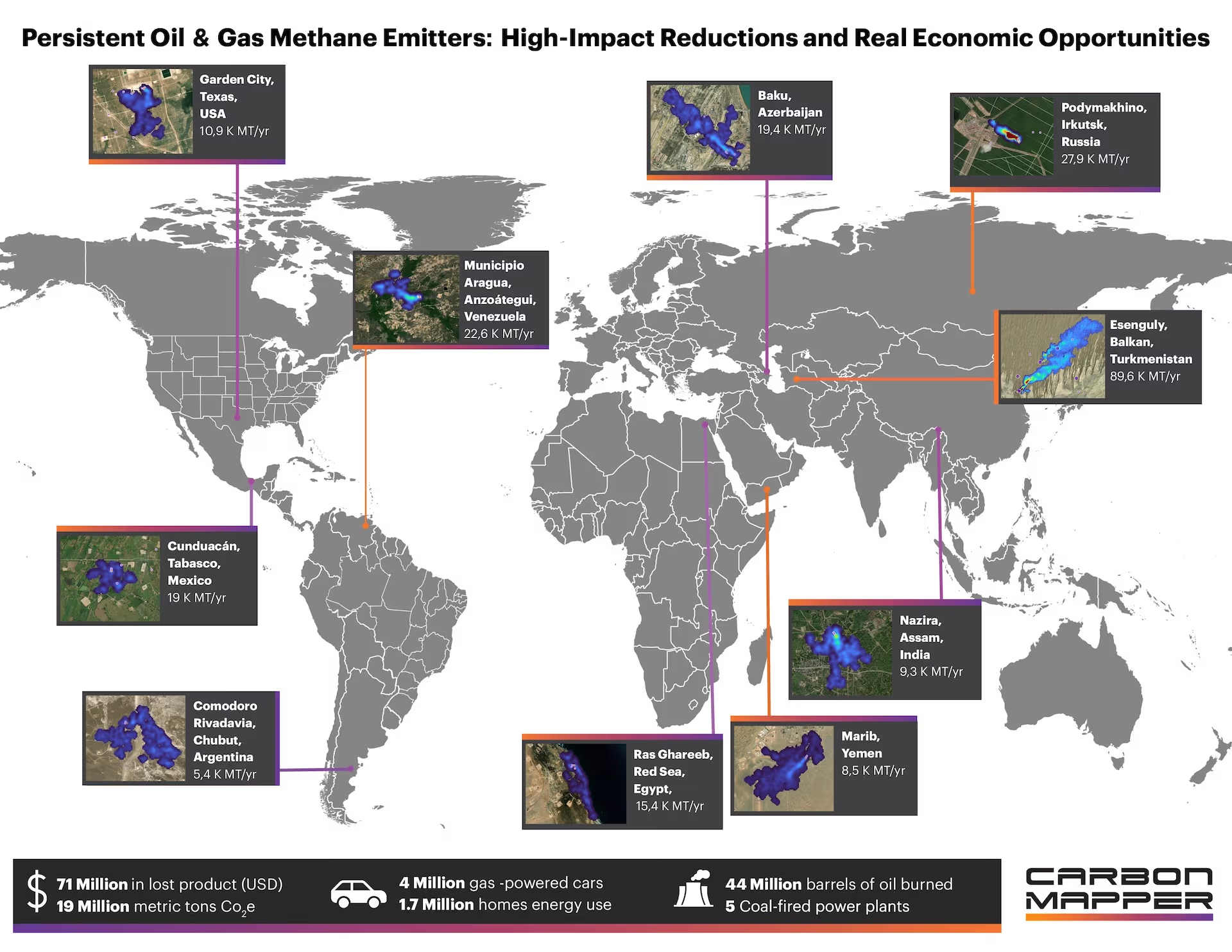
"This infographic shows that mitigating emissions from these ten oil and gas sites around the world could save $71M USD in lost product and prevent the emissions equivalent of 4 million gas‑powered cars" - Carbon Mapper
Persistent Oil & Gas Emitters
The report distinguishes long‑lasting, persistent sources from short, bursty emissions, noting that long‑lasting sources represent a prime opportunity for mitigation. It cites sectors with high persistent emissions and emphasizes that reducing these persistent plumes can yield substantial climate gains while delivering economic benefits through product recovery and avoided losses.
Global Leadership and Collaboration
In the lead‑up to COP30, countries like Brazil have announced measures to detect and mitigate methane from waste using satellite and remote sensing technologies, underscoring a broader move toward data‑driven, global methane leadership. Carbon Mapper emphasizes ongoing collaboration with industry, governments, and civil society to translate satellite data into timely, lasting emissions reductions.
"Some countries are seizing the waste opportunity to demonstrate global methane leadership and leveraging satellite data to help them do so" - Carbon Mapper
Conclusion
Methane data are a crucial but not solitary element of the climate action toolkit. The article stresses that rapid action on the best‑in‑class data can deliver meaningful, near‑term climate wins, while continued collaboration will be essential to scale these insights into lasting emissions reductions across sectors.
"M methane data is only one piece of the methane action puzzle, the challenge – and opportunity – is acting quickly on what we can now clearly see" - Carbon Mapper
